by Robert Braun | Jul 14, 2025 | Resources
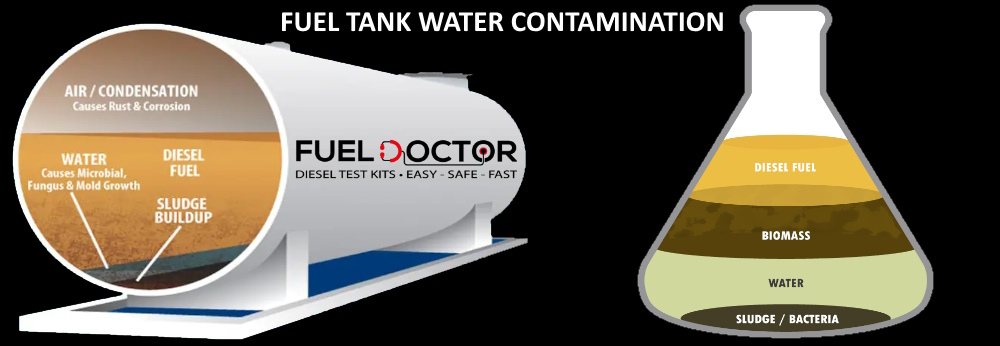
Water and diesel fuel do not make great friends in life if they manage to get together. Water in your fuel will foster the growth of microbial bacteria and these types of bugs can even damage the walls of steel tanks if left unchecked.
This growth has can cause defects to engine and fuel system components, resulting in repairs that will burn your bank balance and also result in your equipment being out of service. Yes, it’s quite normal to find water in your diesel fuel tanks, but there is a fine line when small amounts can turn into a large problem for your engine and it’s reliability.
Acceptable Levels of Water in Diesel Fuel
The acceptable level of water in diesel fuel is no more than 200 mg/L / parts per million as per EN 590 standards. This is the most accurate specification to use for testing methods of your diesel fuel.
Why Water is in Your Diesel Fuel Tank

There are several reasons why water is inside your fuel tank:
Condensation.
Diesel is a stable fuel that produces no fumes unlike gasoline. The lack of vapour in diesel tanks means there is the possibility for air to enter your tank unopposed from any positive pressures. As the daily temperature changes from hot to cold the fuel tank draws in humid air that collects as water condensation on the inside walls of the tank which drops into your fuel. Over time this water condensation can cause large amounts of water in your diesel tanks to accumulate.
Poor Fuel Handling.
Water is often placed into diesel tanks while filling up and when poor handling of the fuel happens due to errors that you have no control of. Fuel stations are usually careful to separate water from their diesel while in storage tanks and when you pump from them, but it’s still possible to transfer water into your rank when refilling from a contaminated tank at a fuel station. You just never know what your getting sometimes from fuel stations.
Tank Caps and Filler System Leaks.
Leaks in filler caps or fuel filler systems can allow water and other contaminants to enter your tank.
Signals Water is in Your Diesel
As mentioned, it’s normal to find small amounts of water in your diesel fuel – you really cannot have zero PPM parts per million of water levels in diesel. If the water level is low then it won’t create issues that you should worry about as your water separator like a Racor filter water separator will take care of this. But be warned that excessive amounts of water in your diesel will allow the growth of microbes to grow. Eventually, this will damage your injectors, your fuel lines, damage your fuel pumps, diesel tanks and key components in your engine.
Key symptoms of water in your diesel tanks to look out for
Engine lacks power
Difficulty in engine starting
Surging up/down idle speeds
White smoke from exhaust system
Damaged fuel injectors and pumps
Testing for Water in Your Diesel Fuel and Tank
Expensive diesel repairs due to water in the system is a common problem, it’s a requirement to keep an eye on the quality of fuel in your tank.
Most diesel-powered vehicles and equipment have a water separator in the fuel system. You can check it yourself to make sure it’s not gathering large amounts of water, a simple drain of the water from the filter like in the images below is usually all you need to do to remove the contamination.

Check the diesel tanks. One of the best ways to test for water is to look into your tanks with a flashlight, visually the fuel should be clear and bright.
Diesel that has become contaminated with water is darker than usual. Clean diesel is clear and light coloured in appearance. Dark or cloudy fuel can tip you off that there is water in the fuel system already.
NB – for tax evasion purposes some fuel makers add coloured dyes to their fuel for identification and law enforcement.
Water in diesel testing kits. You can use water in diesel fuel testing kits that quickly and safely indicates water in your fuel. Our kits can perform tests in just minutes and they can be used in the field or in the workshop without the need for an expensive laboratory analysis.

Summing Up
Water in your diesel tanks can become a problem which result in major repairs if you don’t test on a regular basis. Testing should be a part of your regular engine maintenance program.
by Robert Braun | Jul 12, 2025 | Resources
In the realm of automotive care, fuel additives are often touted as the unsung heroes that help enhance engine performance and efficiency. One such product that has garnered attention is the Liqui Moly Speed Tec Fuel Additive Part 3722.
In this review, we will delve into the specifics of this additive, examining its composition, benefits, and effectiveness in real-world applications.
Introduction to Liqui Moly
Liqui Moly is a German company renowned for its high-quality automotive lubricants, additives, and car care products. With a strong reputation built over decades, Liqui Moly products are trusted by both professionals and enthusiasts globally.
The Speed Tec Fuel Additive Part 3722 is part of their extensive line-up, designed to optimize vehicle performance.
Composition and Purpose
The Liqui Moly Speed Tec Fuel Additive is formulated to enhance the driving experience, particularly focusing on improving the acceleration and responsiveness of the engine. It is designed for use in all two-stroke and four-stroke gasoline engines, making it versatile across a range of vehicles, including cars, motorcycles, and even boats.
Key Ingredients
1. Petroleum Distillates: This component helps in cleaning the fuel system by dissolving deposits and impurities.
2. Synthetic Detergents: These agents work to prevent the build-up of new deposits, ensuring that the fuel system remains clean over time.
3. Combustion Improvers: These additives enhance the combustion process, leading to better fuel efficiency and power output.
Benefits of Speed Tec Fuel Additive
The primary goal of the Speed Tec Fuel Additive is to improve engine performance, and it achieves this in several ways:
1. Enhanced Acceleration: Users have reported noticeable improvements in throttle response, allowing for smoother and more immediate acceleration.
2. Fuel Efficiency: By improving the combustion process, the additive can increase fuel economy. This is particularly beneficial for drivers looking to extend their mileage without compromising on engine performance.
3. Engine Protection: The cleaning agents in the formula help remove existing deposits while preventing new ones from forming, thereby reducing engine wear and extending the life of the vehicle.
4. Versatility: Suitable for various types of gasoline engines, this additive provides flexibility for those with multiple vehicles.
User Experience and Effectiveness
Positive Feedback
Many users have praised Liqui Moly Speed Tec for its immediate impact on engine performance. Reports of smoother idling and quicker acceleration are common, and some users have also noted improvements in fuel economy after consistent use.
The product’s ease of use—simply added to the fuel tank—is another point of appreciation.
Considerations
While the product is generally well-received, some users have expressed skepticism regarding the long-term benefits of fuel additives in general. It’s important to note that while additives can improve performance, they are not a substitute for regular maintenance and using quality fuel.
Application and Usage
Using the Liqui Moly Speed Tec Fuel Additive is straightforward. The manufacturer recommends adding the product to the fuel tank before filling it with gasoline. This ensures optimal mixing and effectiveness. It is suitable for use at regular intervals, particularly when a boost in performance is desired.
Cost and Availability
Liqui Moly products, including the Speed Tec Fuel Additive, are widely available online and in automotive stores. Priced competitively within the market, it offers good value considering its benefits.
While some may view it as an additional expense, the potential savings in fuel costs and engine repairs can offset the initial investment.
Environmental Impact
As with any chemical product, considering environmental impact is essential. Liqui Moly Speed Tec is designed to be as environmentally friendly as possible, minimizing harmful emissions by promoting more complete combustion. Nevertheless, responsible usage and disposal are crucial to reducing environmental harm.
Conclusion
The Liqui Moly Speed Tec Fuel Additive Part 3722 stands out as a reliable choice for drivers looking to enhance their vehicle’s performance.
With its ability to improve acceleration, fuel efficiency, and engine cleanliness, it offers tangible benefits for a wide range of gasoline engines.
While it is not a replacement for regular maintenance, it can be a valuable addition to a comprehensive vehicle care regimen.
For those seeking a noticeable boost in their driving experience, Liqui Moly Speed Tec Fuel Additive is worth considering.
As with any product, results may vary based on individual vehicle conditions and usage patterns, but the overall feedback suggests that this additive delivers on its promises so we give it the big thumbs up.
by Robert Braun | Jul 7, 2025 | Resources
We have examined and reviewed several water detector capsules in the market place for diesel fuel and aviation fuel testing . These “pill” type tests originate from India mostly from what we have noted.
Packaged in a capsule form they look exactly like a medication or supplement pill and are supplied in plastic bottle with a screw top that has no air tight seal. This may become a problem for some users as they may spoil or become less effective if moisture from the air can get into the storage bottle.
How to Use Water Detector Capsule For Diesel Fuel
Obtain a fuel sample of about 100ml / 3.5 fluid ounce into a clear sealed container, making sure you have very dry hands, take one capsule from the storage bottle, split capsule and pour the powder contents into the fuel sample. Shake the sample a little and allow the powder to settle down which may take a few minutes. Check if the powder has changed colour and refer to the original maker instructions for identification of problems.

Brands noted and examined with fit for purpose notes and guidance
Water Detector Capsule for Diesel – Part # Diesocap-H2O
Water Detector Capsule for Aviation fuel – Part # Aviacap-H2O
Water Detector Capsule for Aviation fuel – Part # Aquadis Micro Detectors

Pros –
- They can detect water in diesel and aviation fuel. (depends on the fuel capsule type your have).
Cons –
- They do not check for diesel fuel quality to recognized standards of ASTM D4176.
- They do not check for diesel fuel bacterial problems.
- They do not check for diesel fuel fungus, algae and yeast problems.
- They come packaged in the one container with a plastic lid that appears to not have a good seal to prevent moisture getting into the storage bottle. Constant removal of the top to take out fuel capsules for each test may result in moisture entering and spoiling or limiting the effectiveness of all the capsules. This is the main reason why we do not recommend water detectors in a vitamin pill casing that are stored in the same container with no air tight sealing mechanism. NB: Users in an area with high humidity may have spoilage problems that may effect the accuracy of these types of tests. Some users may not have a problem as we have discussed above, it may depend on each situation and the way the product is handled and used.

Contact notes
Water Detector Capsule for Diesel – Part # Diesocap-H2O – Company name Chemochem India
Water Detector Capsule for Aviation fuel – Part # Aviacap-H2O – Company name Chemochem India
Water Detector Capsule for Aviation fuel – Part # Aquadis Micro Detectors – Company name Kaveri Baag Corporation India
Images used above are for reference and illustration purposes and do not represent the products mentioned.

by Robert Braun | May 26, 2025 | Resources
Diesel fuel serves three major purposes in fuel systems: providing the energy source for the combustion process, removing heat from fuel high pressure injection components and providing lubrication for the high friction moving parts in the fuel system. When fuel is of low quality you can have severe reliability issues so the need for regular fuel testing is of great importance.
Fuel is likely to be the largest single expense faced by diesel engine operators on a day to day basis. It is important to ensure that the fuel you have in your tanks is of highest quality.
In addition to reducing engine performance, contaminated fuel can cause abnormal or catastrophic wear in fuel pumps and injectors.
Testing of your fuel determines if inherent qualities fall within required limits thus ensuring that your diesel fuel remains in good health.
Cat SOS fuel testing factors.
• Biodiesel Content
• Oxidation Stability
• Particle Count
• Pour Point
• Sulfur Content
• Viscosity
• Water Content
• Cetane Index
• Cloud Point
• Microbial Growth
• Distillation Curve
• Elemental Analysis
• Cold Filter Plugging Point
• Density
• Flash Point


How does the testing work?
You simply purchase the SOS fuel test kit from a Caterpillar dealer or agent, depending on your location around the world you may have the options of several tests to choose from with varying costs, order just the basics at a cheaper price to “the works testing” at more expense.
You extract your sample to the test bottle, apply and mark the labels with your data. Get the sample back to the dealer for the test process which will take a day or two for completion.
You can then get the results back via an email, SMS, fax or log-in to the SOS online portal to view the data of your test.
Summary
Cat offers fast, inexpensive and accurate fuel testing, they also have test kits for coolant and oil.
One of the best ways to test your engines fluids to ensure they are in good condition.
How to use the Cat SOS diesel fuel test kit
by Robert Braun | May 26, 2025 | Resources
The ERASPEC fuel analysis unit is fully automated, portable and can test any type of fuel known to man and provide exact fuel specifications. With a patented and rugged design the unit is perfect for fast gasoline, diesel and jet fuel analysis. It’s not a cheap fuel testing unit in purchase price but as they say you get what you pay for.
With its high precision, speed and ease of use, it is perfect for fuel compliance testing, refining quality checks, fraud testing of fuel and research use as well as mobile applications for all your fuel testing needs.
From fuel analysis at terminals, refineries and blending stations, engine manufacturers, auto and equipment workshops, fuel laboratories and many other fuel testing situations this unit is ready to go and it can provide test results in just 60 seconds or less and no need to clean the unit in-between tests – it takes care of that itself!
The unit makes the analysis of gasoline, diesel fuel, or jet fuel fast and simple. Advanced testing modules are available for fuel ethanol, fuel methanol, and even synthetic fuel testing.
The product complies with pretty much all standards know to us including ASTM D5845, D6277, D4052/D7777, D7806; EN 238, EN 14078; ISO 12185, ISO 15212; IP365, IP559 plus US D.O.T, RCRA, NAVY and NATO approved.
It’s a heavy weight in functions but only a lightweight in size at 29 x 35 x 34 cm (11.4 x 13.8 x 13.4 in) and just 10.5 kg (23.1 lb) in weight.
ERASPEC Fuel Analysis unit price cost
The price and final cost on the ERASPEC Fuel Analysis in unit will depend on the unit model, the advanced testing modules that you require (if any) and the country that you are in as extra tax and freight charges may apply to the $ or € purchase price. We did notice a second hand used ERASPEC Fuel Analysis unit on eBay and the price was USD $3,999 with no warranty so it’s not something you should consider buying. So a new unit will cost you quite a bit more than USD $3,999 but it comes with a complete factory warranty and ready to go in testing fuel.
Overview video
Operation video
Summary
Without doubt one of the best fuel analysis units in the market – view official site here
by Robert Braun | May 26, 2025 | Resources
Free water in aviation fuel can have serious consequences, such as ice formation, blockages and engine failure which is not so great when you are 35,000 feet in the air.
Microbial growth in tanks can also result in fuel spoiling and filters being clogged. Even more concerning is the corrosion damage that acids generated by the microbes can lead to.

As it is not possible to detect low concentrations of suspended water through visual inspections alone, there is an easy-to-use test you can count on to make sure your jet fuel meets required aviation standards for water content.
Built with Shell’s high quality requirements, the JM-3764 detector has maintained its reputation as a tried and true industry-standard test for detecting water in aviation fuel for some 50 + years.

How to use
The plastic capsule you attach to a syringe, you draw out 5ml of jet fuel, view the capsule if it changes color to yellow or green water is detected.
Pros
Easy to use
Fast results in minutes
Inexpensive
Cons
Aviation fuel testing only, not suitable for water in diesel fuel testing
Video instructions